- PetroPeak Investments Newsletter
- Posts
- Discipline is winning! Here’s what that means for royalty owners
Discipline is winning! Here’s what that means for royalty owners

John Jordan
May 12, 2026
MARKET PULSE
Something notable happened in Q1 earnings: three of the Permian’s largest operators raised production guidance while holding capital flat
The latest round of quarterly earnings is sending a clear message across U.S. oil and gas: leading operators are still managing the business with capital discipline, but the tone has shifted from purely defensive to selectively constructive.
Several public E&P companies entered 2026 with conservative plans, measured activity levels, and a continued focus on free cash flow. After the first quarter, however, a number of operators are reporting better-than-expected production, improved operating efficiency, and in some cases higher full-year guidance. That does not mean the industry has returned to a growth-at-all-costs mindset. It does suggest that high-quality operators in premier basins are finding room to improve performance without abandoning financial discipline.

SM Energy is a good example. Following its first-quarter results, the company raised full-year 2026 production guidance to 410–430 MBoe/d, up from prior guidance of 400–420 MBoe/d, after first-quarter production exceeded guidance. Importantly, SM maintained its full-year capital spending outlook, which points to improved execution rather than simply spending more to grow.
Diamondback Energy also raised production guidance and increased its base dividend after a strong first quarter. The company reported approximately $1.7 billion of adjusted free cash flow and signaled a more flexible capital allocation approach, including the potential to add rigs and completion activity if market conditions remain favorable.
At PetroPeak, we watch these earnings releases closely. It’s not because we own the stocks, but because operator capital discipline directly influences activity on the mineral positions we hold and target.
EOG Resources reinforced the same broader theme from a different angle: operational execution translating into financial strength. EOG reported $1.5 billion of free cash flow, returned nearly $950 million to shareholders through dividends and buybacks, and noted that oil, gas, and NGL volumes exceeded the midpoints of guidance while maintaining cost discipline.
Even the larger integrated companies continue to emphasize shareholder returns and disciplined capital allocation. Chevron reported that it returned $6.0 billion to shareholders in the first quarter, marking its 16th consecutive quarter above $5 billion in shareholder distributions, while also reporting higher worldwide and U.S. production.
For investors, the takeaway is not simply that production is increasing. The more important point is that the strongest operators are continuing to prove they can adapt to the market while protecting balance sheets, managing costs, and directing capital toward their best assets.
That matters for royalty owners. This dynamic is reflected in PetroPeak’s distributions, averaging 11% quarterly since inception, which have been sustained by exactly this kind of disciplined operator activity on our core positions.
Royalty investors do not carry drilling costs, completion costs, lease operating expenses, or capital overruns. Instead, they benefit when capable operators develop acreage efficiently and bring production online from high-quality basins. When public operators raise guidance, improve well performance, or generate more cash flow from the same capital program, mineral and royalty owners can participate through production-linked income without taking on the operator’s capital burden.
This is the central distinction. In the current market, operator discipline is not a headwind for royalty owners. In many cases, it is a strength. Disciplined operators tend to focus capital on their best rock, strongest returns, and most economic development programs. For mineral owners positioned under those assets, that can support more durable cash flow and more thoughtful long-term development.
The first-quarter earnings season points to a maturing shale business. Growth is still available, but it is increasingly selective. The market is rewarding companies that combine scale, inventory depth, cost control, and capital discipline. For royalty investors, that reinforces the value of owning interests in proven basins operated by financially strong companies with the technical and balance-sheet capacity to keep developing through cycles.
The strongest public operators are not chasing volume for its own sake. They are using disciplined capital programs, better execution, and premier acreage positions to generate cash flow. For royalty owners, that combination can create a powerful setup: exposure to production and commodity upside without the need to fund drilling activity directly.
If you’re curious how we evaluate which operators and basins make the cut for PetroPeak acquisitions, that’s worth a conversation. Book 20 minutes here
Commodity | Current Price ($) | Daily Change |
|---|---|---|
WTI Oil ($) | 98.84 | +0.77 +0.79% |
Henry Hub Gas ($) | 2.92 | +0.01 +0.31% |
Current Rig Count(US lower 48) | Week Change | Year Change |
548 | +1 | -30 |
Prices are as of 05/11/2026 and sourced from oilprice.com. Rig data is provided by WellDatabase.com and as of 05/11/2026.
ROYALTY SPOTLIGHT
Public-market interest in mineral royalties is gaining momentum
If you’ve been wondering whether royalties are a legitimate institutional asset class — Wall Street just answered that question.
WhiteHawk Minerals, a natural gas mineral and royalty company, recently filed for a U.S. initial public offering. The company is focused primarily on natural gas mineral and royalty interests in the Appalachian and Haynesville basins and plans to list on the New York Stock Exchange under the symbol WHK. Reuters reported that WhiteHawk generated $67.6 million of revenue in 2025, up from $9.5 million in 2024, while narrowing its net loss from $11.6 million to $3.6 million over the same period.
For royalty investors, the important takeaway is not the IPO itself. The broader signal is that mineral and royalty assets continue to attract institutional attention because they offer a different form of energy exposure: ownership tied to production revenue, without the same capital obligations carried by operators.

That distinction matters.
An operator must lease acreage, drill wells, complete wells, manage field operations, maintain equipment, handle service costs, and continually reinvest capital to sustain production. A mineral or royalty owner participates in production revenue from wells developed on the acreage but generally does not pay drilling or completion costs. That creates a capital-light model where returns are driven by lease terms, operator activity, commodity prices, basin quality, and the depth of future development inventory.
WhiteHawk’s public filing is another reminder that royalties are not simply passive income assets sitting in the background of the oil and gas industry. They are a recognized asset class with scale, institutional relevance, and strategic value. The company has built its position through multiple acquisitions since its founding in 2022, with Reuters reporting that it manages mineral and royalty interests across roughly 3.4 million gross unit DSU acres focused primarily in Appalachia and the Haynesville.
The timing is also notable. Natural gas is gaining renewed investor interest as LNG exports, power demand, data center growth, and long-term electrification needs continue to shape the energy market. For gas-focused royalty owners, the value of an asset is increasingly tied not only to what sits beneath the acreage, but also to where that acreage is located, which operators are active, how much undeveloped inventory remains, and whether the basin has durable access to end-market demand.
This is where royalty investing becomes more than a commodity-price story. Strong royalty assets are built from the ground up: quality rock, proven development, capable operators, favorable lease terms, clean title, and realistic assumptions about future well activity. Public-market interest in royalty companies reinforces the importance of those fundamentals.
For individual accredited investors, the lesson is straightforward. The same characteristics that appeal to larger institutions (passive exposure, production-linked revenue, basin diversification, operator-driven development, and limited direct operating burden) are also the characteristics that make mineral royalties attractive within a diversified private portfolio.
The royalty model is not new. What is changing is the level of attention it is receiving.
As public operators continue to focus on disciplined development and the market shows renewed interest in scalable royalty platforms, mineral owners remain positioned in a unique part of the energy value chain. They do not need to operate the wells to benefit from production. They need to own the right interests, in the right basins, under the right operators.
Recent public-market activity around mineral and royalty companies reinforces a key point: royalties are increasingly viewed as institutional-quality energy assets. For investors, the appeal is simple but powerful! Exposure to production revenue and commodity upside without taking on the direct capital burden of drilling and operating wells. PetroPeak investors already have access to this asset class. If you know someone who doesn’t — forward this newsletter. They can subscribe at PetropeakNewsletter.
Real Assets. Real Income. Real Alignment. |
BASIN FOCUS
The Permian remains the engine of U.S. shale — but takeaway constraints are a reminder that quality matters
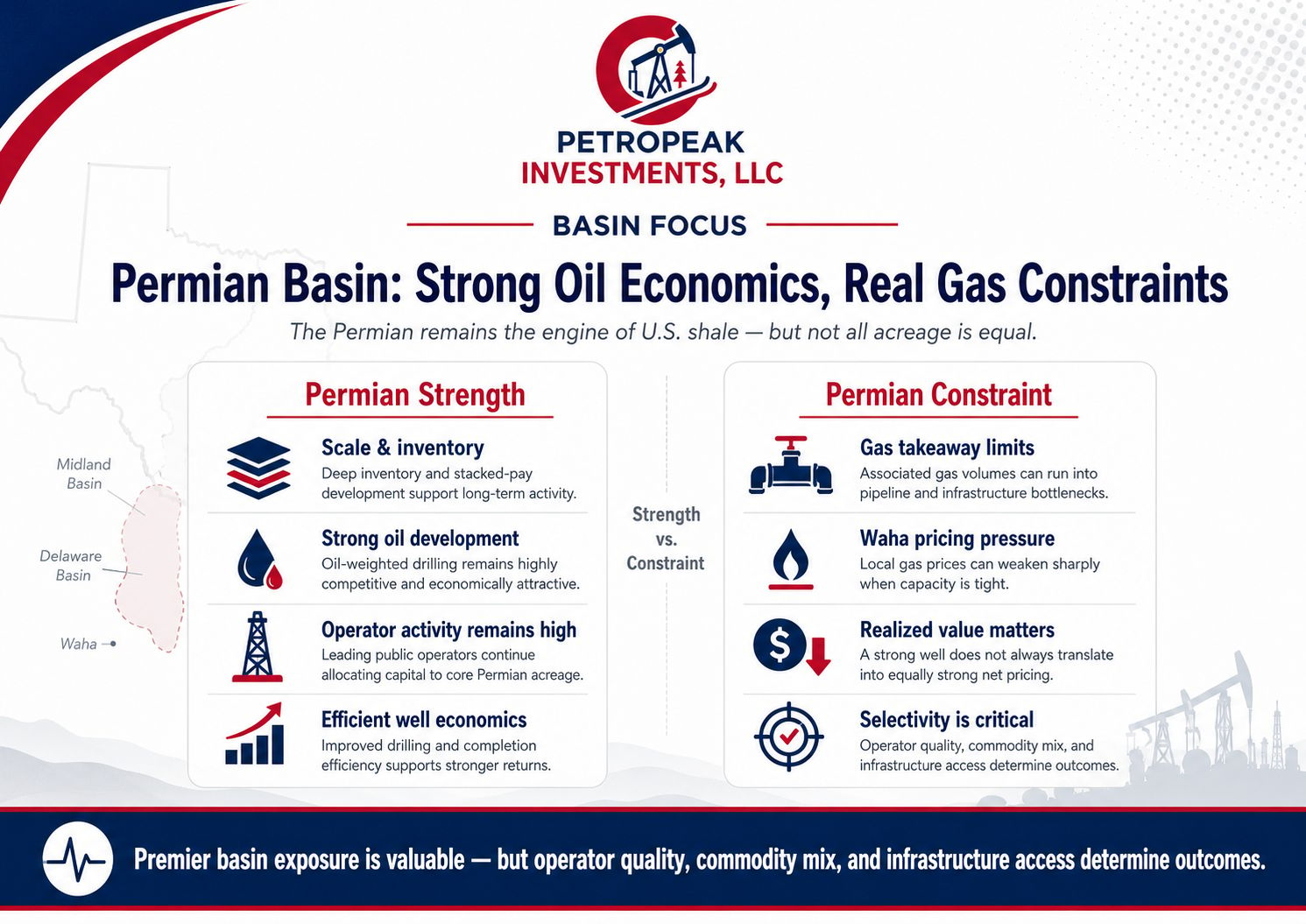
The Permian Basin continues to sit at the center of U.S. oil and gas development. Recent quarterly results from several public operators reinforced the same message: high-quality Permian acreage remains competitive, scalable, and capable of generating strong returns even in a disciplined capital environment.
But the Permian story is not one-dimensional.
On the oil side, the basin continues to show why it attracts so much operator capital. Diamondback Energy raised its 2026 production outlook after a strong first quarter, with Reuters reporting that the company plans to add up to three rigs and operate five completion crews during the remainder of the year. Diamondback’s first-quarter production increased year over year, and the company continues to lean into the basin’s ability to generate cash flow when oil prices and well economics are supportive.
Permian Resources delivered a similar message. The company increased the midpoint of its full-year oil production guidance to 192.5 MBbls/d, reduced drilling and completion costs to $685 per lateral foot and maintained a strong balance sheet with leverage of approximately 0.8x. Those are not just production metrics. They speak to the operating efficiency and repeatability that make premier Permian positions valuable.
APA also pointed to Permian efficiency as a driver of stronger U.S. oil performance. The company raised its full-year U.S. oil production outlook to 122,000 barrels per day, while keeping Permian capital spending unchanged at $1.3 billion. That is an important distinction: higher expected oil production without a corresponding increase in Permian capital suggests better uptime, improved execution, and stronger capital efficiency.
For mineral and royalty owners, this is the positive side of the Permian story. When capable operators improve well performance, reduce costs, and raise production expectations without materially increasing capital, royalty owners can benefit from production-linked revenue without funding the drilling program directly. The operator takes on the capital burden. The royalty owner participates through the lease.
However, the basin’s strength also comes with a persistent constraint: natural gas takeaway.
Permian wells often produce meaningful associated gas along with oil. When pipeline capacity is tight or downstream demand is temporarily constrained, local gas pricing can weaken sharply. Natural Gas Intelligence recently reported that Waha hub prices averaged approximately negative $5.658/MMBtu in April amid restricted takeaway capacity. A separate NGI report noted that Waha prices remained deeply discounted as pipeline limits continued to pressure the West Texas gas market. | Waha hub gas averaged -$0.66/MMBtu in April — a reminder that basin exposure and asset quality are not the same thing. |
That does not undermine the Permian investment thesis, but it does sharpen it.
The best Permian opportunities are not simply defined by being “in the Permian.” They are defined by the quality of the rock, the operator, the lease terms, the development plan, the oil-versus-gas mix, and the asset’s access to infrastructure. Two royalty interests in the same broad basin can behave very differently depending on where they sit and who operates them.
For oil-weighted royalty exposure, strong Permian development can be highly attractive. Oil remains the primary economic driver across much of the basin, and leading operators continue to allocate capital toward their highest-return inventory. But gas constraints are a reminder that realized pricing matters. A well can be technically strong and still face weaker economics if associated gas receives distressed local pricing.
This is where disciplined underwriting becomes critical. Royalty evaluation should not stop at production history or headline basin exposure. It should account for operator quality, gathering and takeaway access, commodity mix, development timing, and the likelihood that future wells will be drilled in an economically rational sequence.
The Permian remains the dominant U.S. shale basin because it combines scale, stacked pay, deep inventory, and a large base of technically capable operators. Recent quarterly results support that view. But the Waha pricing issue reinforces a more nuanced point: basin quality is only the starting point. Asset-level quality determines the outcome.
For royalty investors, that nuance is an advantage. The goal is not to own random exposure to a basin. The goal is to own mineral and royalty interests beneath the right operators, in the right development fairways, with the right commodity exposure and infrastructure support.
The Permian continues to offer some of the strongest development opportunities in U.S. shale, but recent gas pricing pressure shows why selectivity matters. Royalty investors benefit most when exposure is tied to high-quality acreage, disciplined operators, strong oil economics, and access to reliable markets — not simply a recognizable basin name. We are actively evaluating Permian royalty positions that meet exactly these criteria. If you’re an accredited investor interested in participating in the next acquisition, now is a good time to connect. Connect With Us
INVESTOR ADVANTAGE
Royalty investors can benefit from operator execution without funding the drilling program
One of the most important advantages of mineral and royalty investing is the separation between who develops the asset and who receives income from production.
Consider a royalty interest under a Permian operator running a 3-rig development program. That operator will spend 50–200M over the next two years drilling wells across the acreage. The royalty owner spends nothing and participates in every barrel produced.
Royalty owners sit in a different position. When a royalty interest is located beneath active, high-quality development, the royalty owner receives a share of production revenue without paying the drilling and completion costs required to bring that production online. That does not remove all risk since commodity prices, decline rates, operator activity, title quality, and lease terms still matter. But it does create a very different investment profile than owning and operating wells directly.
That distinction is especially relevant in the current market.
Recent quarterly results show that leading operators are still focused on disciplined capital allocation. They are not broadly chasing volume growth at any cost. Instead, many are directing capital toward their strongest acreage, improving well productivity, managing costs, and returning cash to shareholders. For royalty investors, this can be a constructive setup. Disciplined operators tend to prioritize the assets with the best economics. If a royalty owner is positioned beneath those assets, development activity may be more deliberate, but it is often more economically resilient.
This is where operator quality becomes a key underwriting factor.
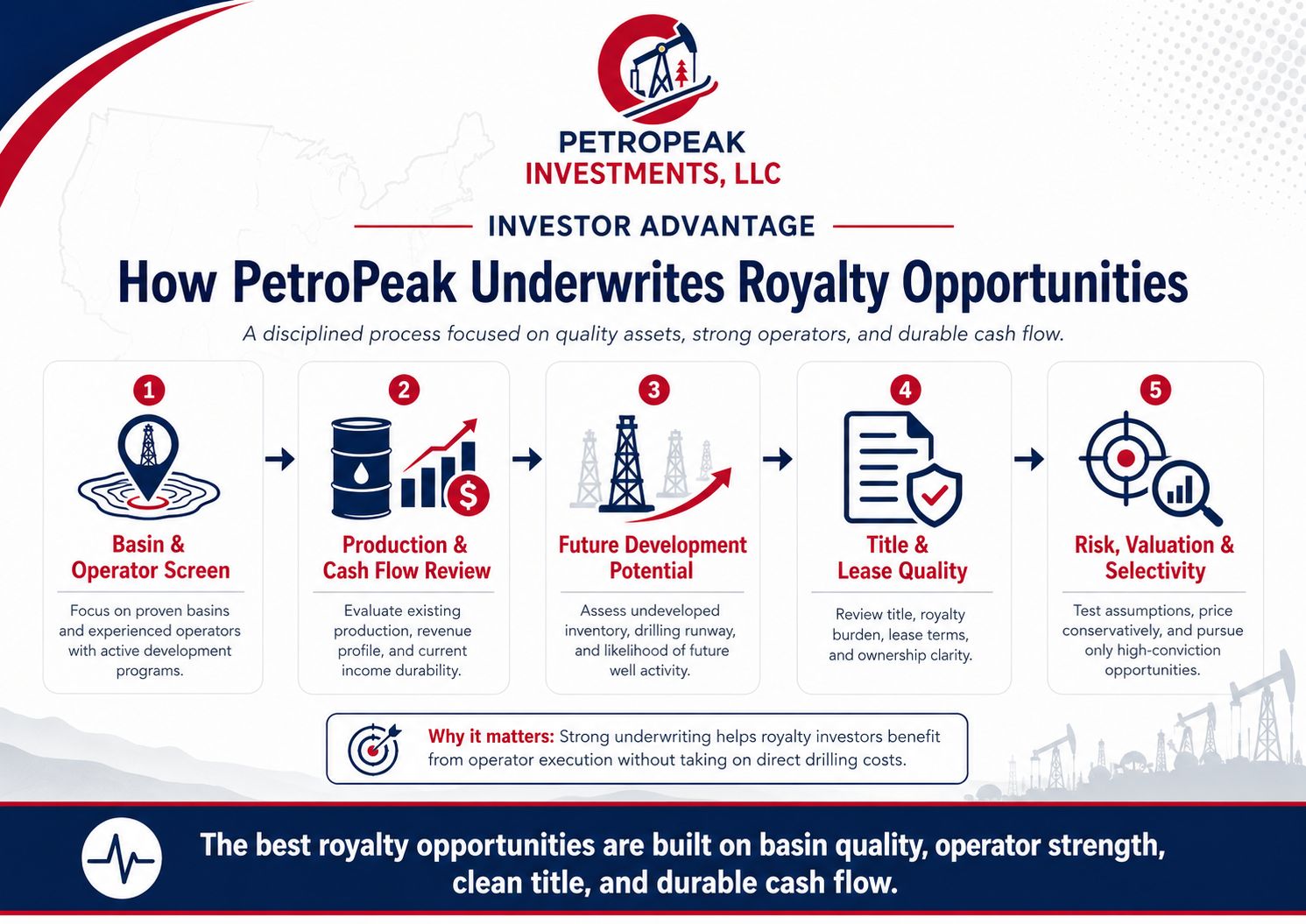
A royalty interest under a well-capitalized, technically capable operator is not the same as a royalty interest under an operator with limited capital, weaker inventory, or inconsistent execution. Strong operators have the balance sheets, infrastructure relationships, technical teams, and development planning discipline to keep assets moving through cycles. They are more likely to drill where returns justify capital, manage operations efficiently, and bring production online in a way that supports long-term asset value.
For investors, this creates a useful lens: royalty investing is not simply a bet on oil or natural gas prices. It is a bet on the combination of basin quality, operator strength, lease structure, existing production, and future development potential.
That combination is what can make royalties attractive in a diversified portfolio. The income is tied to real production from tangible assets. The upside is connected to commodity prices and future drilling. The investor is not responsible for the capital program. And when minerals are diversified across basins, operators, wells, and commodity types, the result can be a more balanced form of energy exposure than a single well, single operator, or single public stock.
The current earnings season reinforces that point. Public companies are continuing to show that shale development is becoming more efficient, more data-driven, and more financially disciplined. That creates opportunities for royalty owners, but it also raises the standard for selection. The most attractive royalty assets are not necessarily the ones with the highest headline yield today. They are the ones with durable existing cash flow, credible future development, clean title, favorable lease terms, and operators with the capacity to execute.
At PetroPeak, this is the core of the investment approach. The goal is not to speculate on undeveloped acreage or chase short-term commodity moves. The goal is to build diversified royalty exposure in proven basins where quality operators are already active and where future development can continue to refresh cash flow over time.
LOOKING AHEAD
What Q1 earnings really mean on the ground
After 30 years drilling wells across every major U.S. shale basin, I can tell you what the Q1 earnings season actually means on the ground: operators are not simply talking about growth again. They are showing where they have confidence, where they have inventory, and where they believe capital can still generate attractive returns.
That is an important distinction.
When a public company raises production guidance, improves well performance, or talks about adding rigs, it is easy to read the headline as a broad industry signal. But in the field, capital is never spread evenly. It moves toward the best rock, the strongest economics, the most reliable infrastructure, and the teams that can execute. The earnings season is not telling us that every basin, every operator, or every acre is suddenly more valuable. It is telling us that selectivity still matters.
That is exactly how we think about royalties at PetroPeak.
Royalty owners do not decide where the rig goes next. They do not control completion schedules, service costs, or drilling efficiencies. Their income depends on being positioned under the right operators, in the right basins, with the right development potential. That is why underwriting matters so much. A royalty interest is only as strong as the asset beneath it, the lease terms attached to it, and the operator responsible for developing it.
The Permian is a good example. It remains the engine of U.S. shale because of its scale, stacked pay, and depth of inventory. But even in the Permian, not all acreage is equal. Recent gas pricing pressure at Waha is a reminder that commodity mix, gathering systems, takeaway capacity, and realized pricing can all influence value. Owning minerals in a premier basin is not enough by itself. The real question is whether the asset has the right combination of oil exposure, operator quality, infrastructure access, and future drilling inventory.
Natural gas tells a similar story. LNG exports, power demand, data center growth, and electrification are creating a stronger long-term case for U.S. gas. But gas markets are still highly regional. Location matters. Basis matters. Infrastructure matters. The assets that benefit most will likely be those connected to reliable markets and operated by companies with the capital discipline to develop them through cycles.
That is the practical lesson from this earnings season.
The best operators are not chasing volume for the sake of volume. They are protecting balance sheets, improving efficiency, and allocating capital to the places where they believe returns justify the investment. For royalty investors, that can be a powerful setup. When the operator funds the well, manages the project, and executes the development plan, the royalty owner can participate in production revenue without taking on direct drilling costs or operating responsibility.
But the opportunity is not automatic. It has to be earned through disciplined asset selection.
At PetroPeak, our focus remains straightforward: acquire royalty interests with existing cash flow, credible future development, strong operators, clean title, and asset-level fundamentals that can support durable income over time. We are not trying to chase every headline or speculate on every commodity move. We are looking for real assets in proven basins where development activity can continue to refresh cash flow over time.
Looking ahead, I will be watching the follow-through. Do guidance increases turn into real activity? Do operators keep capital discipline intact? Do infrastructure constraints improve? Does natural gas demand continue to strengthen through LNG and power demand? Does consolidation keep moving quality acreage into stronger hands?
Those are the questions that matter beyond the earnings headlines.
For investors, the larger point is simple: the U.S. shale industry has matured. The best companies are more disciplined, more technical, and more focused on cash generation than they were in prior cycles. That evolution plays directly into the royalty model. Royalty ownership gives investors a way to participate in production, operator execution, and future development potential without having to fund the drilling program themselves.
After decades in this business, I have learned that good assets reveal themselves over time. The strongest opportunities are rarely found in the loudest headlines. They are found in the details: the operator, the rock, the lease, the development plan, the infrastructure, and the cash flow.
That is where PetroPeak is focused. We are currently in diligence on two royalty positions and have capacity for new investors in our next acquisition. If you’d like to see the deal summary, reply to this email or book a call before May 30th.
If you’re looking to position capital alongside these trends, we’d welcome the conversation. Visit petropeakinvest.com to learn more or connect with us directly.