- PetroPeak Investments Newsletter
- Posts
- Newsletter #3
Newsletter #3

John Jordan
September 30, 2025

MARKET PULSE
Growth Isn’t Free — How Discipline Is Driving the Next Shale Cycle
Over the past few years, the U.S. shale industry has matured—and the era of “drill at all cost” is giving way to a new paradigm: capital discipline over volume growth. Today’s operators are walking a tightrope, balancing investor expectations, commodity volatility, and the need for sustainable margins.
According to the Dallas Fed’s Energy Survey, many upstream companies are signaling a conservative posture for 2025, focusing on maintenance capex rather than aggressive expansion.
Meanwhile, E&P operators have already trimmed their 2025 capital budgets: a recent RBN Energy analysis shows a ~4% aggregate cut across oil-weighted operators due to pricing uncertainty and tariff risks.
TotalEnergies announced it will slash its capital expenditures by $1 billion annually through 2030, reducing its 2026 net CapEx guidance to ~$16 billion and tightening its growth plans across the energy portfolio.
In the Permian, Diamondback Energy has quietly scaled back its capex by another $100 million, citing modest near-term upside and prioritizing debt reduction.
This shift isn’t just about cost control—it’s repositioning the value play. When operators restrain spending on low-return projects, royalty holders benefit: you still get paid on every barrel produced, regardless of how many new wells are brought online.
Outlook & Risks
If oil prices stay stable or strengthen, modest growth is feasible. But structural headwinds—rising breakevens, service inflation, transport bottlenecks, and regulatory uncertainty—will limit upside. The next leg of growth in shale will favor disciplined operators who combine technical efficiency with cost control.
For investors, the message is clear: in a capital-constrained environment, royalty ownership becomes even more strategic. Operators who resist chasing growth may deliver better returns—and more predictable cash flows.
WTI Oil ($) | 63.06 | -2.66 -4.05% |
Henry Hub Gas ($) | 3.26 | +0.06 +1.75% |
Current Rig Count(US lower 48) | Week Change | Year Change |
549 | +7 | -38 |
*Prices are as of 09/29/2025 and sourced from oilprice.com. Rig data is provided by WellDatabase.com and as of 09/29/2025.
ROYALTY SPOTLIGHT
The Power of the Depletion Allowance
One of the most overlooked — and valuable — aspects of oil and gas royalty ownership is the depletion allowance. For investors, it’s not just about the income you earn, but how much of that income you keep after taxes.
The IRS recognizes that oil and gas reserves are a finite resource. To account for this, royalty owners are allowed to deduct 15% of their gross royalty income each year as a tax-free allowance. Unlike depreciation, which spreads deductions over time, depletion is applied annually against cash flow, creating an immediate benefit.
Here’s what that means in practice:
If you earn $100,000 in royalty income, $15,000 is shielded from federal taxes through the depletion allowance.
This can substantially improve after-tax returns compared to other income-producing assets like bonds, REITs, or dividend-paying stocks.
Importantly, royalty owners don’t have drilling or operating expenses to deduct, making depletion one of the few available tax advantages.
For accredited investors, this is a key differentiator. The depletion allowance enhances yield, protects against tax drag, and underscores why royalties remain a favored income strategy among institutions and family offices.
At PetroPeak, we highlight this benefit to ensure our investors not only understand the income potential of royalties, but also the unique tax efficiency that comes with them.
BASIN FOCUS
Uinta Basin — Consolidation, Constraints, and the Road Ahead
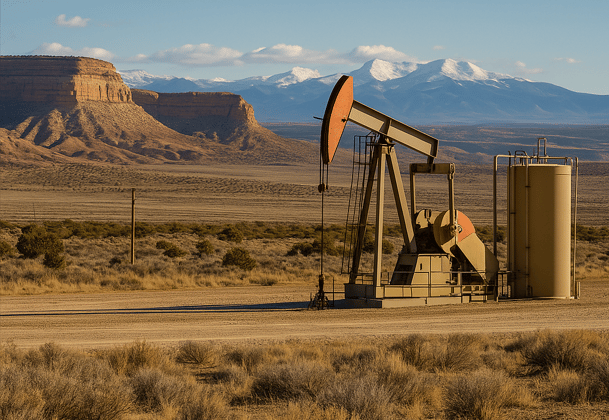
Over the last year, the Uinta Basin in northeastern Utah has re-emerged as one of the most closely watched oil plays in the U.S. Recent acquisitions, production gains, and operator shifts have sparked renewed attention in a basin long considered secondary to the Permian or Bakken. But as the dust settles from a wave of M&A, questions remain: how much growth lies ahead, and what hurdles could slow the pace?
Recent A&D Activity
SM Energy made headlines in 2024 with its $2.04 billion acquisition of XCL Resources’ Uinta assets, adding ~37,200 net acres and ~43,000 Boe/d of production. This deal cemented SM as a major basin operator.
Ovintiv exited the basin, selling ~126,000 net acres (~29,000 bbl/d) to FourPoint for roughly $2 billion.
Berry Corp., with ~100,000 oily acres, is now part of California Resources Corp. (CRC) following a $717 million acquisition. Analysts speculate CRC may divest Berry’s Uinta position, which could spark another round of dealmaking.
Production Growth
SM Energy’s Q2 2025 release highlighted 32% year-over-year production growth, with oil volumes up nearly 60% — much of it tied to Uinta. Berry and its peers are also reporting improved economics, with new horizontal wells achieving 55–60 bbl/ft EURs and ~20% lower well costs thanks to dual-fuel fleets and water recycling. These efficiency gains, coupled with horizontal development across multiple formations, point to meaningful upside.
Infrastructure & Market Constraints
Despite the momentum, the Uinta Basin faces challenges:
Transport Bottlenecks: Uinta’s waxy crude requires heated railcars or specialized pipelines, adding cost and limiting takeaway. Without new midstream capacity, growth will face natural limits.
Competition for Markets: While refiners in Salt Lake City and the Gulf Coast offer outlets, Uinta barrels must compete with Permian and Bakken crude.
Capital Discipline: Operators are cautious in today’s $60 WTI environment, prioritizing high-return drilling over volume growth.
The Road Ahead
The basin’s growth isn’t unlimited, but it remains compelling. Expect the following themes:
Consolidation: SM is positioned as the anchor operator, while CRC/Berry’s next move could reshape acreage ownership.
Private Equity Activity: Players like FourPoint and Scout will remain active in horizontal development.
Potential for Double-Digit Growth: With stable oil prices and improved logistics, the Uinta could sustain meaningful production increases through 2030.
The Uinta Basin is proving that disciplined capital deployment and operational efficiency can drive growth even in challenging markets. For royalty investors, the opportunity is clear: steady income without drilling risk. As operators like SM Energy scale production and private equity-backed firms push development forward, royalty owners stand to benefit from every incremental barrel. At PetroPeak, our focus is on sourcing these types of high-quality mineral rights, giving investors access to upside while avoiding the capital and operational risks shouldered by operators.
INVESTOR ADVANTAGE
Passive Returns, No Capital Calls
One of the biggest frustrations accredited investors face when entering private investments is the unexpected demand for more capital. Whether in real estate, private equity, or traditional oil and gas partnerships, investors are often surprised by capital calls that reduce liquidity and shift the risk back onto them.
With mineral and royalty interests, the model is different. When you invest with PetroPeak, your commitment is defined up front — there are no ongoing capital calls, no drilling costs, and no hidden surprises down the line. Once the asset is acquired, your only role is to collect the income distributions that flow from production.
This distinction is powerful. It means:
Predictable exposure: Your capital is at work immediately in producing assets.
Truly passive income: Distributions arrive without operational obligations.
Risk control: You’re insulated from cost overruns, delays, or operating expenses that typically hit working interest owners.
In a world where too many “alternative investments” turn out to be anything but hands-off, royalties stand apart. At PetroPeak, we’re focused on making energy investing simple, transparent, and reliable — income without the burden of being an operator.
LOOKING AHEAD
Royalties as an Inflation Hedge
Next week, we’ll dive into one of the most powerful — and timely — advantages of oil and gas royalties: their role as a natural hedge against inflation. While traditional fixed-income investments lose ground as costs rise, royalty income often increases with commodity prices. We’ll explore how this dynamic protects investor wealth and why royalties continue to stand out as a durable, inflation-resistant asset class.
Ready to Take the Next Step?
At PetroPeak, our mission is to make energy investing simple, transparent, and rewarding. If you’re ready to explore how oil and gas royalties can strengthen your portfolio with real cash flow and real assets, we’d love to connect.
Ways to Connect with Us:
Email: [email protected]
Website: www.petropeakinvest.com
Schedule a Call: Book a time here
Follow us on LinkedIn and socials: PetroPeak Investments LLC, @petropeakinvest
Whether you’re exploring royalties for the first time or looking to deepen your exposure, PetroPeak can guide you through every step — from understanding the asset class to participating in high-quality, cash-flowing deals.
Because at PetroPeak, it’s about more than just investing. It’s about building long-term income you can count on.