- PetroPeak Investments Newsletter
- Posts
- Newsletter Nov 11,2025
Newsletter Nov 11,2025

John Jordan
November 11, 2025

MARKET PULSE
E&Ps Tighten the Belt While Consolidation Accelerates
As quarterly results rolled in, one message rang consistent across U.S. exploration and production companies — discipline is the new growth strategy. The shale patch continues to balance capital restraint with steady productivity gains, demonstrating that financial strength now trumps headline production numbers.
Executives from every major independent echoed the same refrain: “maximize cash flow, minimize spend.” Efficiency gains, improved well performance, and tighter cost control are driving free cash flow across the board, while M&A momentum underscores the sector’s ongoing push toward scale and resilience.
Early Highlights from Q3 Guidance & Earnings Releases
EOG Resources – Reported Q3 oil, gas, and NGL volumes above guidance midpoints, with lower per-unit costs reinforcing its “returns first” philosophy.
SM Energy – Held its full-year framework steady and issued Q4 guidance of ~206–212 Mboe/d on $225–$245 MM capex, trimming taxes and exploration spending while maintaining disciplined margins.
Ovintiv – Raised production guidance while keeping capital flat, projecting ~$1.65 B in 2025 FCF at $60 WTI — a textbook example of “doing more with less.”
Coterra Energy – Delivered volumes near the top of guidance and lifted 2025 outlook while maintaining mid-range capex — consistent, steady performance with a focus on efficiency.
Devon Energy – Targeting a $1 B free cash flow uplift by 2026, driven by cost reductions and supply chain optimization — all without expanding its rig count.
Civitas Resources – Posted strong Q3 results, reduced cash operating costs, and reinstated capital returns (dividends + buybacks), reinforcing its shareholder-first approach.
The M&A Momentum Continues
The drive for efficiency isn’t just internal — it’s strategic. The past two weeks have seen a surge in corporate consolidation tied to quarterly results:
SM Energy and Civitas Resources announced a $12.8 billion all-stock merger, creating a top-tier independent spanning the Permian and DJ Basins.
Ovintiv agreed to acquire NuVista Energy in a C$5.5 billion all-stock transaction, expanding its foothold in the Montney and strengthening its North American gas portfolio.
Additional consolidation chatter continues, with private equity–backed operators evaluating exits amid stable pricing and strong public balance sheets.
The Takeaway for Investors
The trend is clear: flat-to-modest production growth, constrained capital, and an emphasis on free cash flow — now reinforced by corporate combinations seeking scale and efficiency. For royalty investors, this environment is constructive. Steady development activity, lower cost structures, and disciplined operators translate to durable production and reliable royalty income — without the risk of capital exposure.
Commodity | Current Price ($) | Daily Change |
|---|---|---|
WTI Oil ($) | 60.14 | +0.39 +0.65% |
Henry Hub Gas ($) | 4.36 | +0.02 +0.53% |
Current Rig Count(US lower 48) | Week Change | Year Change |
558 | +2 | -39 |
*Prices are as of 11/10/2025 and sourced from oilprice.com. Rig data is provided by WellDatabase.com and as of 11/10/2025.
ROYALTY SPOTLIGHT
Energy Transition Realities — Why Fossil Fuels Aren’t Going Away Anytime Soon
As hype around “end of oil & gas” narratives grows, recent research and industry feedback suggest a starkly different story: hydrocarbons remain central to global energy supply and investor strategy. For example, the International Energy Agency (IEA) reports that global energy demand rose by 2.2 % in 2024 — led by oil (+0.8 %) and natural gas (+2.7 %). Meanwhile, the McKinsey Global Institute argues the transition is not linear, noting the “hard stuff” of infrastructure and legacy assets still dominate the mix.
At the recent Energy Intelligence Forum, executives described natural gas as a “destination fuel” — not just a bridge — due to its role in grid stability, power generation and data center demand. Major integrated energy companies are also reacting: many are refocusing on upstream oil and gas rather than betting solely on renewables, citing energy security and demand growth.
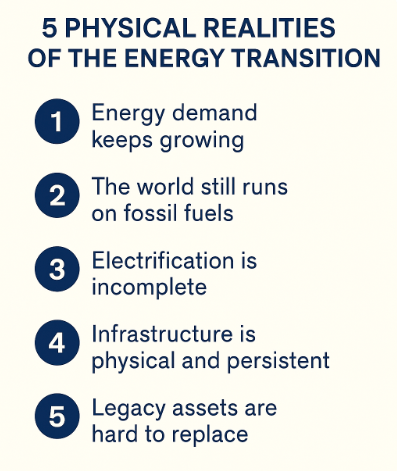
For royalty investors, this creates compelling implications. A slower transition supports steady demand for fossil-based energy, while disciplined production and tight investment underscore premium pricing potential for those receiving royalties from existing wells. In short: while clean energy advances, the real-world mix for decades will continue to include oil & gas — and that means royalty streams tied to these assets remain relevant, resilient and strategically defensive.
BASIN FOCUS
Basin Focus: Western Haynesville — Gas Gains Across the Border
The Haynesville Shale has long been a key U.S. gas province — but what’s grabbing attention recently is the western expansion of the play into parts of East Texas and southeast Oklahoma. Leading the charge are companies like Expand Energy, Comstock Resources and Aethon Energy, each mobilizing acreage and capital into the far-western Haynesville corridor.

Expand recently added 75,000+ net acres in the Western Haynesville, positioning itself for improved margins and deeper inventory in a basin tied closely to Gulf Coast LNG and industrial gas demand. Comstock, under the leadership of Jerry Jones, is drilling wells over 19,000 feet with lateral lengths nearing 20,000 ft, claiming breakeven oil-equivalent economics and projecting potential “$100 billion” value in the play. Meanwhile, Aethon’s efforts are being watched globally: a potential ~$8 billion acquisition by Mitsubishi Corporation would underscore the strategic value of this corridor adjacent to LNG export infrastructure.
What does this mean for royalty investors? First, the western Haynesville provides new inventory in a gas-centered resource play, allowing mineral/royalty exposure in an area benefiting from both domestic demand and export escalation. Its proximity to Gulf Coast infrastructure reduces takeaway risk and supports cash-flow visibility. On the flip side, the technical challenges remain real: deeper wells, higher temperatures, and longer laterals mean costs need to stay disciplined, and production consistency must be proven beyond the first handful of wells.
At PetroPeak, we’re monitoring the Western Haynesville closely. We believe this corridor is emerging as a viable source of gas-driven royalty cash flow, complementing oil-centric basins and offering diversification in the energy income portfolio.
INVESTOR ADVANTAGE
At the Top of the Stream — Why Free Cash Flow Matters
One theme has dominated every corporate earnings call this quarter: free cash flow!! From large-cap operators like EOG and Devon to independents like SM Energy and Civitas, companies are emphasizing capital discipline, efficient development, and returning cash to shareholders. But for royalty investors, the power of free cash flow isn’t just a metric — it’s a direct advantage.
When an operator sells oil or gas, the royalty owner is paid first, before operating expenses, capital costs, or debt service. That means royalty income flows straight from production revenue, independent of whether an operator increases drilling or trims its capital budget. Even as companies cut spending and prioritize efficiency, the royalty stream remains tied to real production, not balance-sheet decisions.
As recent M&A and corporate guidance reinforce, operators are focusing less on volume and more on margin — and that discipline works in favor of those holding mineral and royalty interests. With fewer high-risk growth projects and steadier output, royalty income becomes more predictable, sustainable, and inflation-resilient.
At PetroPeak, we invest in the front end of the revenue stream — where investors receive income from energy production itself, not from speculative growth. Because when the industry focuses on free cash flow, royalty owners already sit at the top of the payout ladder.
LOOKING AHEAD
The Next Chapter in Energy M&A
The wave of consolidation sweeping through U.S. oil and gas isn’t slowing — but it may be evolving. After a string of blockbuster mergers including Exxon–Pioneer, Chevron–Hess, and most recently SM Energy–Civitas and Ovintiv–NuVista, the question now is: what comes next?
From one perspective, the rationale for scale remains strong. Larger, multi-basin companies can spread costs, leverage shared infrastructure, and deliver the operational efficiency investors demand. Many analysts still see room for mid-cap and private operators to combine — particularly in the Permian, Haynesville, and DJ Basin, where cost synergies and contiguous acreage can translate directly into cash flow.
But the counterpoint is equally valid: the era of transformational “mega-deals” may be giving way to a new phase — portfolio rationalization. As the largest independents and majors digest recent acquisitions, we may see non-core acreage carved out, with smaller firms or mineral aggregators stepping in to capture value from these asset sales.
For investors, that shift could open the door to new royalty and mineral opportunities — deals born not from expansion, but from optimization.
At PetroPeak, we’ll be watching both sides of this story closely: where the next merger wave breaks, and where disciplined buyers can turn divestitures into cash-flowing assets.
Ways to Connect with Us:
Email: [email protected]
Website: www.petropeakinvest.com
Schedule a Call: Book a time here
Follow us on LinkedIn and socials: PetroPeak Investments LLC, @petropeakinvest
Whether you’re exploring royalties for the first time or looking to deepen your exposure, PetroPeak can guide you through every step — from understanding the asset class to participating in high-quality, cash-flowing deals.
Because at PetroPeak, it’s about more than just investing. It’s about building long-term income you can count on.